GSoC 2026: X.509 Certificate Generator Templates
Published on by Sarthak Tyagi
Category: gsoc
Tags: gsoc openwisp-controller x509 certificates new-features
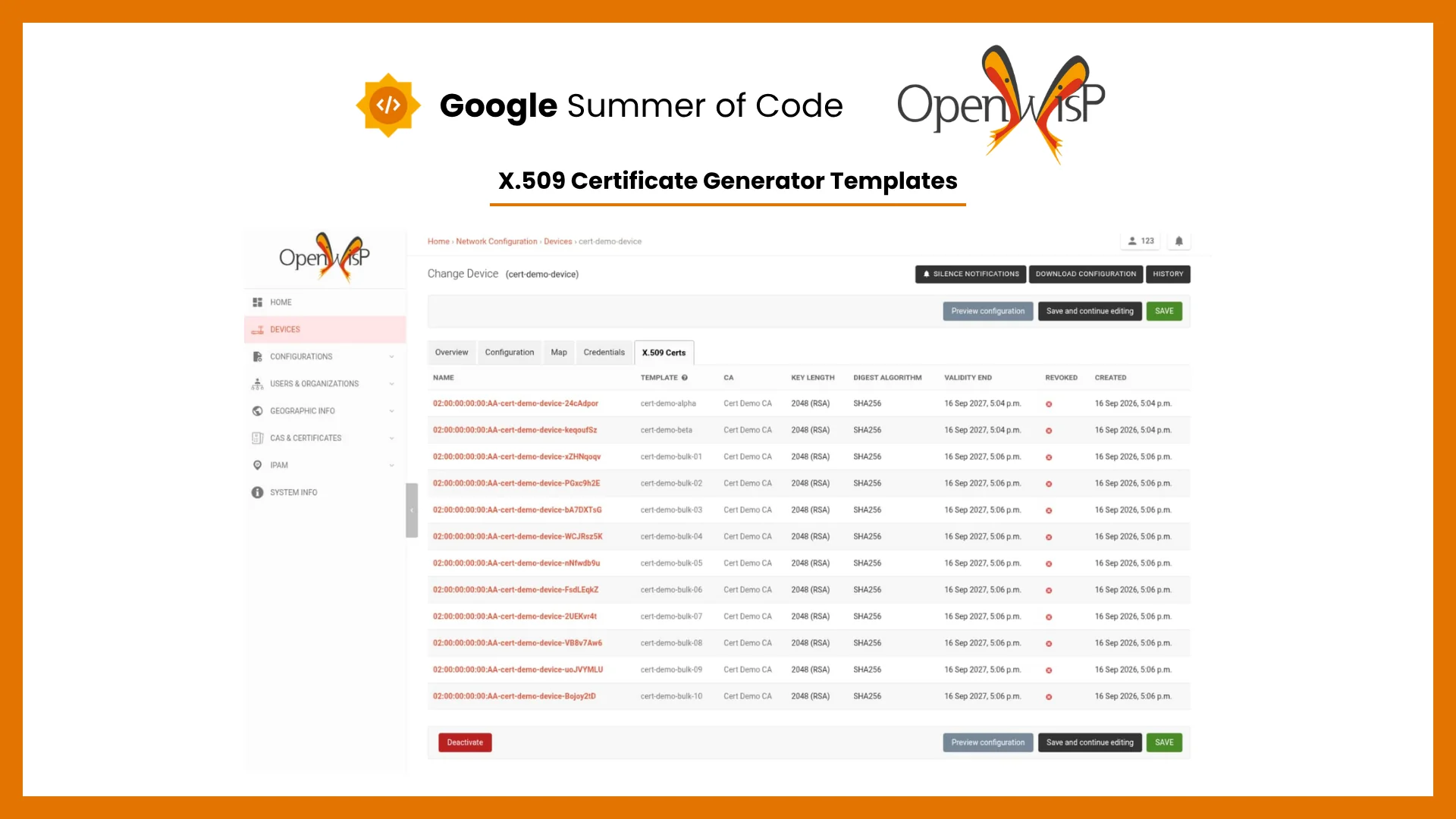
Google Summer of Code with OpenWISP has easily been one of the highlights of my journey as a developer. Over the last three months I worked on bringing standalone X.509 certificate generation to the platform, which gave me the chance to explore unfamiliar corners of the stack, take on tricky problems, and ship a feature that frees certificate management from being tied exclusively to VPN tunnels, turning it into a general-purpose capability. None of this would have been possible without the steady guidance and expertise of my mentors Federico Capoano (nemesifier) and Aryaman (Aryamanz29). Their thoughtful feedback, patience, and generous mentorship were invaluable in helping me grow both as a developer and as an open-source contributor.
About the Project
Until now, OpenWISP could generate X.509 certificates only for OpenVPN clients, where each VPN client template produces a certificate signed by the CA linked to the corresponding VPN server. Anyone who needed a certificate for a different purpose, such as securing a web service, authenticating devices against an internal API, or using device identities with 802.1x or captive portals, was forced to attach an unnecessary VPN configuration just to obtain one.
The project makes certificate generation a first-class, general-purpose feature. Administrators can now create a Certificate generator template, choose the Certificate Authority that signs the certificates and, optionally, an existing certificate to reuse as a blueprint. OpenWISP then generates a certificate automatically for every device the template is assigned to. That certificate is bound to the device's cryptographic identity, can be consumed by the configuration engine, and is revoked automatically when it is no longer needed.
The work adds a set of enhancements to openwisp-controller:
- a new template type and relational model;
- an automated provisioning and revocation lifecycle;
- custom device identification OIDs;
- context variables for configuration templates;
- automatic regeneration on hardware changes;
- Django admin and REST API integration;
- documentation that ties everything together.
Building X.509 Certificate Generator Templates
The feature was built incrementally, one piece at a time. The data model came first, extending the existing AbstractTemplate to support a new cert type and introducing the relational bridge that links each generated certificate to a device configuration and to the template that produced it. The lifecycle engine followed, so that assigning a template generates a certificate in the same transaction, unassigning it revokes the certificate, and renewing it triggers a configuration update. With the backend in place, the certificate payload was exposed to the configuration engine as UUID-namespaced variables, automatic regeneration on hardware changes was added to keep certificates in sync with the devices, and finally the Django admin and the REST API were updated to make the whole feature usable from the browser and from automation scripts.
Features Implemented
Certificate Template Model
A new cert type was added to the existing AbstractTemplate model, exposed in the admin as Certificate generator, together with two new relational fields:
- ca, a required ForeignKey to the pki.Ca model that signs the generated certificates;
- blueprint_cert, an optional ForeignKey to the pki.Cert model whose non-unique properties are copied to every newly generated certificate.
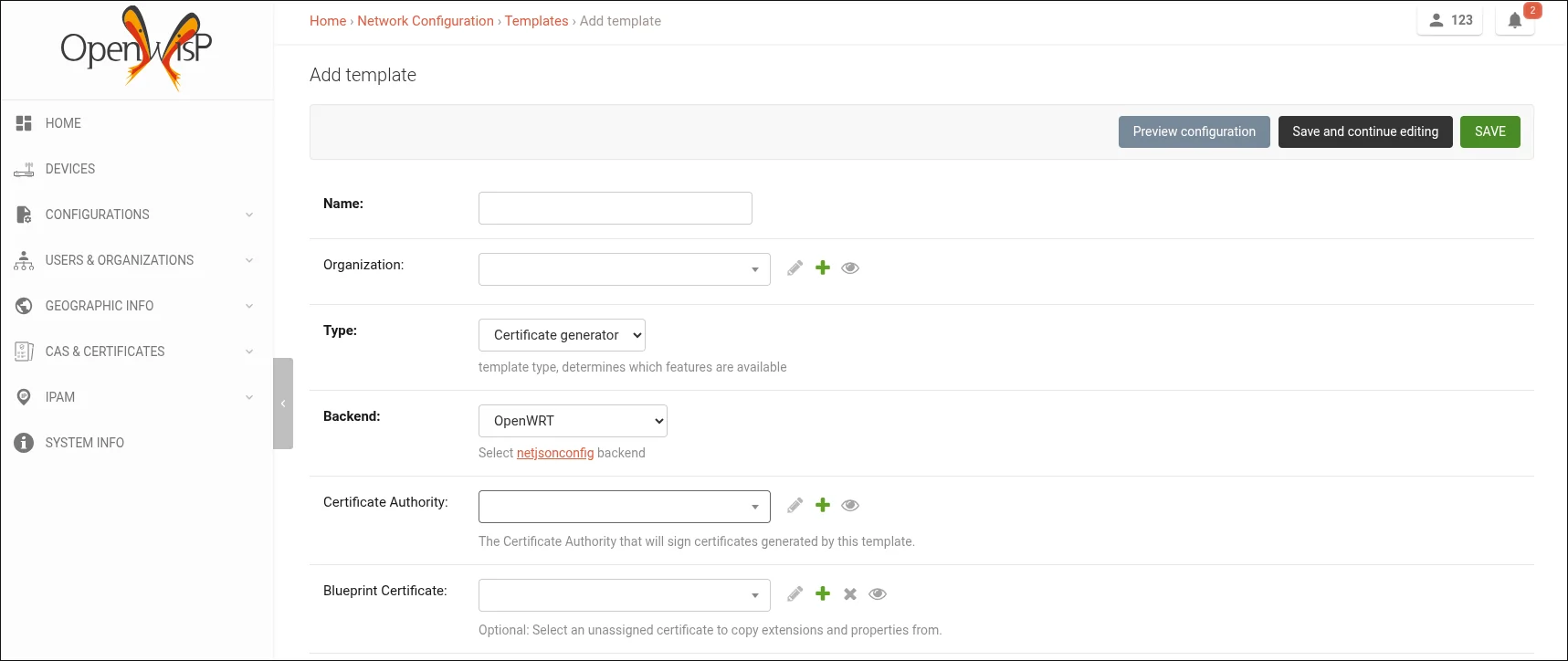
Certificate generator templates always provision certificates automatically, so their auto_cert value is implicitly enabled and is not configurable. A set of validation rules protects the cryptographic integrity of the templates:
- the CA is strictly required for cert templates;
- the blueprint must be signed by the selected CA;
- the blueprint must not already be assigned to a device;
- the CA and the blueprint must belong to the same organization as the template, or be shared.
%%{init: {"theme": "base", "themeVariables": {
  "lineColor": "#8b949e", "textColor": "#1f2933", "nodeTextColor": "#1f2933",
  "edgeLabelBackground": "#f1f3f5"
}, "flowchart": {"nodeSpacing": 40, "rankSpacing": 55}}}%%
flowchart TB
    A["Create Certificate generator
template"] --> B{"CA selected?"}
    B -->|"No"| X["Rejected"]
    B -->|"Yes"| C{"Blueprint provided?"}
    C -->|"No"| OK["Template valid"]
    C -->|"Yes"| D{"Blueprint signed
by this CA?"}
    D -->|"No"| X
    D -->|"Yes"| E{"Blueprint unassigned
and not revoked?"}
    E -->|"No"| X
    E -->|"Yes"| F{"Same organization
as template, or shared?"}
    F -->|"No"| X
    F -->|"Yes"| OK
    classDef entry fill:#dbeafe,stroke:#2563eb,color:#1e3a8a,font-weight:bold
    classDef waiting fill:#fff1e0,stroke:#ed7800,color:#1f2933,font-weight:bold
    classDef success fill:#2f855a,stroke:#276749,color:#ffffff,font-weight:bold
    classDef failure fill:#c53030,stroke:#9b2c2c,color:#ffffff,font-weight:bold
    class A entry
    class B,C,D,E,F waiting
    class OK success
    class X failure
When the template type is not cert, the two certificate fields are cleared automatically.
A new DeviceCertificate intermediate Many-To-Many model acts as a strict relational bridge between the device configuration, the template and the generated certificate. It stores a config and a template foreign key and a cert one-to-one relationship, and enforces a unique_together constraint on (config, template) so that a single configuration can never generate conflicting certificates from the same template.
Provisioning and Revocation Lifecycle
Certificate generation follows the same lifecycle semantics as the existing OpenVPN client certificates, but for standalone certificates:
- Assignment generates a certificate. When a certificate template is added to a device configuration, a DeviceCertificate relationship is created and an X.509 certificate is generated and signed in the same database transaction. The subject and extensions are copied from the blueprint certificate when one is provided, otherwise they fall back to the CA defaults, and the certificate's common name is built from the OPENWISP_CONTROLLER_COMMON_NAME_FORMAT setting, suffixed with a unique slug to prevent collisions.
- Unassignment revokes the certificate. When the template is removed from a configuration, the DeviceCertificate relationship is deleted and the underlying certificate is automatically revoked, adding it to the CA's Certificate Revocation List, so that relying parties that obtain and check current revocation information can reject the certificate.
- Renewal regenerates the certificate. Renewing a standalone certificate through the PKI endpoint regenerates the certificate and private key, and the dependency registered in Config.get_cache_dependencies() resolves the DeviceCertificate relationship and updates the affected configuration status, so the device pulls the renewed certificate on its next check-in.
%%{init: {"theme": "base", "themeVariables": {
  "lineColor": "#8b949e", "textColor": "#1f2933", "nodeTextColor": "#1f2933",
  "edgeLabelBackground": "#f1f3f5"
}, "flowchart": {"nodeSpacing": 40, "rankSpacing": 60}}}%%
flowchart TB
    A["Certificate template assigned
to a device configuration"] --> B["DeviceCertificate
link created"]
    B --> C["X.509 certificate generated
and signed by the CA"]
    C --> D["Certificate active
on the device"]
    D -->|"Template unassigned"| E["DeviceCertificate deleted
certificate revoked"]
    E --> F["Added to the CA
Certificate Revocation List"]
    D -->|"Renewal via PKI endpoint"| G["Certificate and private key
regenerated"]
    G -->|"Configuration marked outdated"| H["Device checks in"]
    H --> D
    classDef entry fill:#dbeafe,stroke:#2563eb,color:#1e3a8a,font-weight:bold
    classDef active fill:#ed7800,stroke:#b35b00,color:#ffffff,font-weight:bold
    classDef waiting fill:#fff1e0,stroke:#ed7800,color:#1f2933,font-weight:bold
    classDef success fill:#2f855a,stroke:#276749,color:#ffffff,font-weight:bold
    classDef failure fill:#c53030,stroke:#9b2c2c,color:#ffffff,font-weight:bold
    class A entry
    class B waiting
    class C,G,H active
    class D success
    class E,F failure
Because the private keys and certificates are stored and protected using the existing django-x509 mechanisms, no new encryption scheme, private key download endpoint or permission model was introduced.
Custom Device Identification OIDs
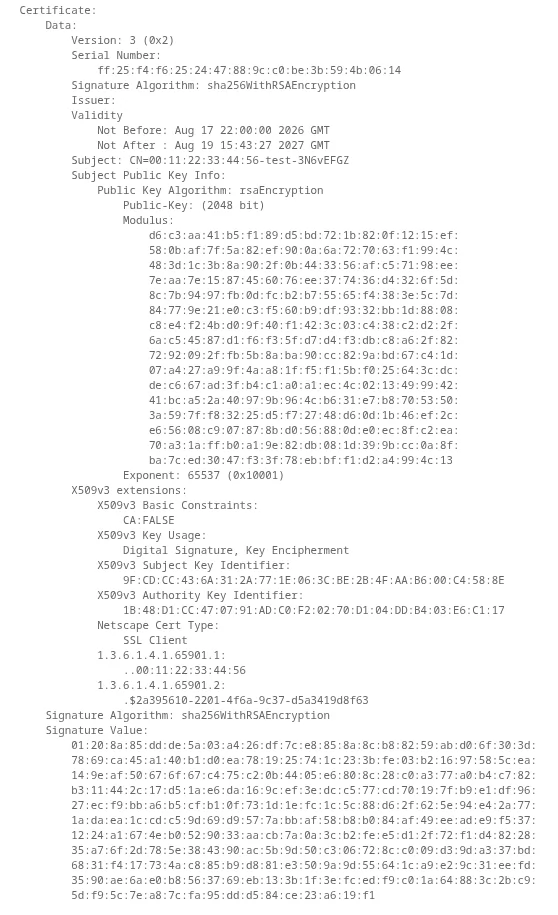
Every automatically generated certificate includes two custom ASN.1 Object Identifiers that cryptographically bind it to the device:
- 1.3.6.1.4.1.65901.1: the MAC address of the device;
- 1.3.6.1.4.1.65901.2: the UUID of the device.
This allows external systems to uniquely and securely identify a device by parsing its certificate. If the blueprint certificate already contains either reserved OpenWISP hardware OID, the inherited value is replaced with the value of the device using the template, so the certificate always reflects the actual hardware.
Certificate Regeneration on Hardware Change
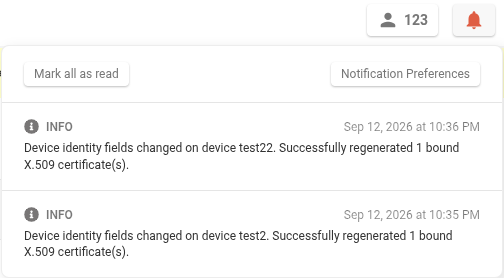
Because the device name and MAC address are bound to the certificate through the common name and the custom OIDs, any change to those hardware properties would otherwise leave the device with a stale and inaccurate identity. A background task now monitors the device's hostname and MAC address and, when a change is detected on a device holding a DeviceCertificate, revokes the outdated certificate and generates a new one with the updated identity attributes. A generic_message notification is sent to the administrator once the regeneration is complete, and the whole behavior can be disabled with the OPENWISP_CONTROLLER_REGENERATE_CERTS_ON_HARDWARE_CHANGE setting.
%%{init: {"theme": "base", "themeVariables": {
  "lineColor": "#8b949e", "textColor": "#1f2933", "nodeTextColor": "#1f2933",
  "edgeLabelBackground": "#f1f3f5"
}, "flowchart": {"nodeSpacing": 40, "rankSpacing": 55}}}%%
flowchart TB
    A["Background task watches devices
holding a DeviceCertificate"] --> B{"Hostname or MAC
changed?"}
    B -->|"No"| A
    B -->|"Yes"| C["Certificate regeneration"]
    C --> D["Revoke outdated certificate"]
    D --> E["Generate new certificate
with updated identity"]
    E --> F["Notify administrators"]
    classDef entry fill:#dbeafe,stroke:#2563eb,color:#1e3a8a,font-weight:bold
    classDef active fill:#ed7800,stroke:#b35b00,color:#ffffff,font-weight:bold
    classDef waiting fill:#fff1e0,stroke:#ed7800,color:#1f2933,font-weight:bold
    classDef success fill:#2f855a,stroke:#276749,color:#ffffff,font-weight:bold
    class A,C,D active
    class B waiting
    class E success
    class F entry
Context Injection
To make the certificate usable, its payload is exposed to OpenWISP's configuration engine as template variables. The Config.get_context() method was extended to iterate over the device certificates and build a dictionary of variables namespaced with the 32-character hexadecimal UUID of the template, which avoids collisions when multiple certificate templates are assigned to the same device:
- {{ cert_<template_uuid_hex>_pem }}: the public certificate;
- {{ cert_<template_uuid_hex>_key }}: the private key;
- {{ cert_<template_uuid_hex>_id }}: the ID of the generated certificate;
- {{ cert_<template_uuid_hex>_path }}: the path where the certificate file is installed on the device;
- {{ cert_<template_uuid_hex>_key_path }}: the path where the private key file is installed on the device.
Administrators can reference these variables inside the JSON configuration payload of any template, and OpenWISP replaces them with the exact certificate and private key generated for that specific device.
Django Admin and REST API
The Django admin was updated so that certificate templates can actually be configured: the new Certificate generator type appears in the type dropdown, the Certificate Authority and Blueprint Certificate fields are shown or hidden based on the selected type, and both foreign keys use raw_id_fields to stay scalable in large deployments. The blueprint dropdown is filtered to show only unassigned, non-revoked certificates and is scoped to the template's organization. The device admin gained a dedicated certificate tab that lists the certificates generated for a device, and links the template name to its detail page, opening in a new tab.
Because changing the core parameters of a template that is already in use would break the binding with the devices, an Active Template Mutation Lock blocks changes to the type, organization, CA and blueprint of a template while it is assigned to active devices. The lock is enforced both in the admin and at the serializer level, so the same protection applies to the API.
The certificate template type is fully supported by the existing REST API: the type field accepts the cert enumeration, ca and blueprint_cert are writable on /api/v1/controller/template/, and patching the templates array of a device triggers the same creation and revocation lifecycle described above. Requesting an already-assigned or revoked certificate as a blueprint, or attempting a locked mutation, returns a 400 Bad Request.
Current State
The complete work is available in openwisp-controller and is documented, both for the admin workflow and for the REST API. The project was delivered incrementally through a series of focused issues and pull requests, all of which were gathered in the implementation pull request and consolidated into the final pull request:
- Extend AbstractTemplate for X.509 Certificates
- Introduce DeviceCertificate relational model
- Update Django admin for Certificate templates
- Implement certificate lifecycle management and integration
- Implement auto-regeneration of certificates on device update
- Expose certificate data as template variables
- Integrate Certificate Templates into REST API
- Documentation for X.509 Certificate generator templates
- Show automatically generated x509 certificates in device admin
- [feature] Added X.509 Certificate Generator Templates #1378
- [feature] Added X.509 Certificate Generator Templates #1486
The dedicated documentation page is X.509 Certificate Generator Templates.
My Experience
Google Summer of Code with OpenWISP turned out to be an enriching experience, and building something that spans cryptography, the database, the configuration engine and the user interface all at once stretched me in ways I had not anticipated. Watching an idea from the GSoC ideas page become a fully working feature, more than five thousand lines of code spread across four dozen files, is something I am genuinely proud of.
The most valuable part of the program was working alongside Federico Capoano (nemesifier) and Aryaman (Aryamanz29). Their reviews were detailed and demanding in the best possible way, nudging me to reason about multi-tenancy and organization scoping, transactional integrity while generating certificates, the idempotency of background tasks, race conditions when a CA or template changes while devices are still using it, and the small user-experience details that decide whether a feature holds up in production. I learned a great deal, and I am keenly aware of how much is still left to learn.
Getting the certificate lifecycle right, keeping generated certificates in sync with the device hardware, and keeping context injection collision-free for devices that use multiple certificate templates were the toughest challenges. Working through them taught me how to split a large feature into pieces that can each be reviewed and merged on their own, and how much it matters to write tests that exercise the real database and signal paths instead of mocking them away.
Beyond the code, joining in the community's discussions was, once again, something I truly enjoyed. I hope to remain involved and give back to the community even more over the coming years.
What's Next?
I plan to keep contributing actively to OpenWISP, working on bug fixes, adding new enhancements and supporting new contributors in their open-source journey. Now that I have an in-depth understanding of the OpenWISP codebase, I am also interested in maintaining and evolving the features I developed during GSoC.
One direction I would like to explore is making the standalone certificate templates the underlying base for VPN client certificate management as well. Today VpnClient still handles certificate creation, renewal and revocation through its own tied-in logic and signal handlers, while the new DeviceCertificate model provides a generalized framework for the same operations. Keeping these two parallel paths means duplicated code and the risk that fixes or improvements made to one never reach the other, so the goal is to refactor VpnClient to reuse the standalone infrastructure: moving the shared lifecycle into a common layer, standardizing signal handlers and transaction atomicity, synchronizing CRL updates across both implementations, and reusing the same renewal and regeneration behavior on both sides. This work is tracked in openwisp-controller issue #1449.